

What It Takes to Stand Out in Ivy League Admissions
The most elite private club in the nation receives tens of thousands of applications each year, accepts single-digit percentages of applicants, connects members with a network of world leaders, CEOs, and celebrities, and charges $80,000 in yearly dues. No, it’s not the Aman Club—it’s the Ivy League.
Many of the parents navigating the admissions process know a great deal about exclusive networks. They’ve built companies, sat on boards, and earned seats at tables most people never see. So when their children set their sights on Harvard, Yale or Princeton, they often bring the instincts that served them in business: do their research, invest in the inputs, optimize for the outcome.
In principle, this approach would seem logical. After all, there is more information available than ever before about the admissions process at elite institutions. We know, for instance, that Harvard admissions officers evaluate applicants, assigning ratings from 1-6 (with 1 being the most desirable score) on categories including their academic achievement, extracurricular involvement, and athletic prowess, as well as the strengths of their recommendations and their interview. We know that submitting test scores often boosts students’ applications, regardless of whether students deem them “good enough” or not, even at test-optional schools.
However, despite this wealth of information, many families still feel overwhelmed and unsure of how to prepare their children for the competitive admissions landscape. The biggest challenge students face today is not knowing what colleges want, but instead becoming those kinds of applicants.
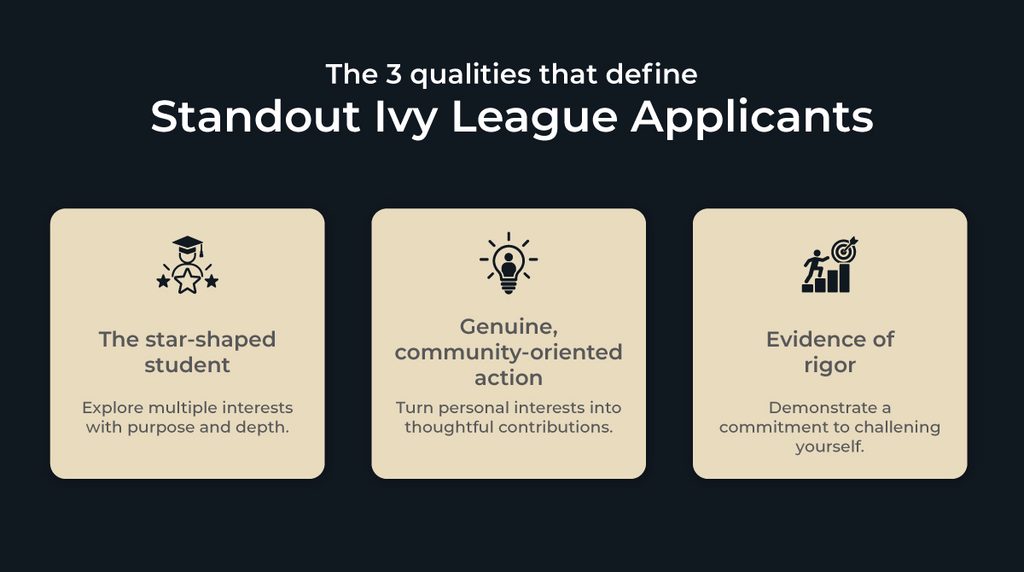
Command Education, a national leader in private college admissions consulting, has pioneered a dual-expertise mentorship model of college consulting, bringing together former admissions officers and Ivy League graduates to give families the most comprehensive information in the industry regarding what it takes to succeed at the nation’s most competitive colleges. According to their experts, these are the three defining features of successful applications at the world’s most competitive colleges:
1. The Star-Shaped Student
Most families know that colleges are no longer looking for well-rounded students. For the past decade, the standard advice in college admissions has been that colleges seek well-rounded classes made up of “pointy” specialists, students who have single-mindedly pursued their core passion.
But this advice has largely run its course. As students overwhelmingly pursued singular interests, applications began to look contrived and manufactured. Admissions officers know that high school students may not have their professional path perfectly laid out—what they care about is self-motivation, intellectual curiosity, and a clear sense of purpose. Colleges still want evidence that a student has meaningfully explored their interests and developed a clear sense of what drives them; they simply no longer expect that drive to point in only one direction.
In light of this, the students who stand out today are what we might call “star-shaped.” Their academic and extracurricular endeavors have been oriented toward a few key areas of inquiry that they have pursued with intentionality and depth. The goal is not for students to shoehorn themselves into a singular specialization, but rather to demonstrate curiosity across a range of topics and fields, academic or otherwise, and seek creative ways to bring those diverse interests together.
2. Genuine, Community-Oriented Action
Nearly every high school student understands that admissions officers care as much about a student’s academic transcript as they do their service record. Because of this, “passion projects” have become a prime way for students to showcase their community-mindedness to prestigious universities.
The impulse that underlies the rise of passion projects is a correct one—admissions officers at top schools want to admit students who are creative and driven, self-motivated and passionate about using their skills to benefit their communities. A well-executed passion project is a compelling and memorable way to convey these qualities and demonstrate the kind of community member they will be on campus.
But the key lies in the term “well-executed.” A decade ago, starting a small business or galvanizing volunteer efforts in one’s community was enough to stand out at competitive schools. Today, as more and more students list passion projects on their applications, the differentiator isn’t the existence of the project, but the thoughtfulness and execution behind it.
The projects that stand out develop organically out of a genuine, specific connection between the student and the problem, not a grand gesture toward good citizenship. A student interested in architecture and political science, for instance, might conduct research in their community about affordable housing issues and present their findings at a city council or zoning board meeting, turning research into advocacy for a problem facing their community. While this type of action is not world-changing or news-breaking, it tells a more compelling story about the student, their background, and what matters to them than a flashy global project could.
3. Evidence of Rigor—In and Outside of the Classroom
Particularly as grade inflation is on the rise, 4.0 GPA means little to an Ivy League admissions officer if it doesn’t correspond to challenging coursework. It is critical that students demonstrate their preparedness for rigorous collegiate coursework by enrolling in the most challenging courses available to them at their schools (whether AP, IB, or Honors)—particularly for courses related to their intended major. If their school offers limited advanced courses, they should take the initiative to enroll in college courses, online classes, or prestigious summer programs to enrich their academic skill set.
While this is the baseline for top college admissions, what distinguishes a winning applicant from the rest is often their academic pursuits outside of the classroom. The strongest applicants show evidence of taking their learning outside of the confines of traditional academic settings by participating in competitive summer programs, independent research with an academic mentor, or college-level and online coursework. In many cases, the rigor of these programs can signal a student’s credentials to admissions officers—many merit-based summer programs, for instance, have acceptance rates that rival even the Ivy League’s. But just as important as the program’s competitiveness is what a student does with their learning. By cultivating their network, reflecting on their experiences, and continuing their learning after the program or research project concludes, students can develop their independent academic initiatives into standout elements of their applications.
In this era of “holistic reviews,” admissions officers are ultimately looking for students who are earnest, genuine, and motivated by authentic passions. Those qualities cannot be manufactured, nor do they develop spontaneously a few months before application deadlines. As Command Education’s ten-year record in admissions attests, these qualities are only developed over time, when students receive the investment and support of someone who truly cares about their development.
The most exclusive club in America has never been harder to join, but the students who earn their place rarely get there by themselves. They get there with the right people in their corner from the very beginning.
About the Author

Grace Lee
SVP of Business Development at Command Education
Grace brings nearly a decade of expertise in educational consulting and business development. A Cornell University graduate with a Bachelor of Science from the SC Johnson College of Business, Grace has a proven track record of driving growth in the education sector.
Recent Posts
Professional Development
 1 min read
 1 min read
ビデオ会議を成功させるためのヒント...
ビジネスの世界でビデオ会議を行うことは、今に始まったことではありません。しかし、ビジネスがオフィスモデルから在宅モデルへと移行するにつれ、ビデオ会議を使いこなすことが必須となっています。ビデオ会議を初めて利用する方で、スムーズにコミュニケーションを取りたいとお考えの方は、ぜひ参考にしてみてください。ここでは、ビデオ会議のプロになるために実践できるヒ…
Professional Development
3 min read
Embrace Excellence Podcast: Le...
Embrace Excellence Podcast: Leadership, Resilience & Entrepreneurship in ActionEmbrace Excellence, the official podcast of CorporateConnections® India—Andhra Pradesh &…