

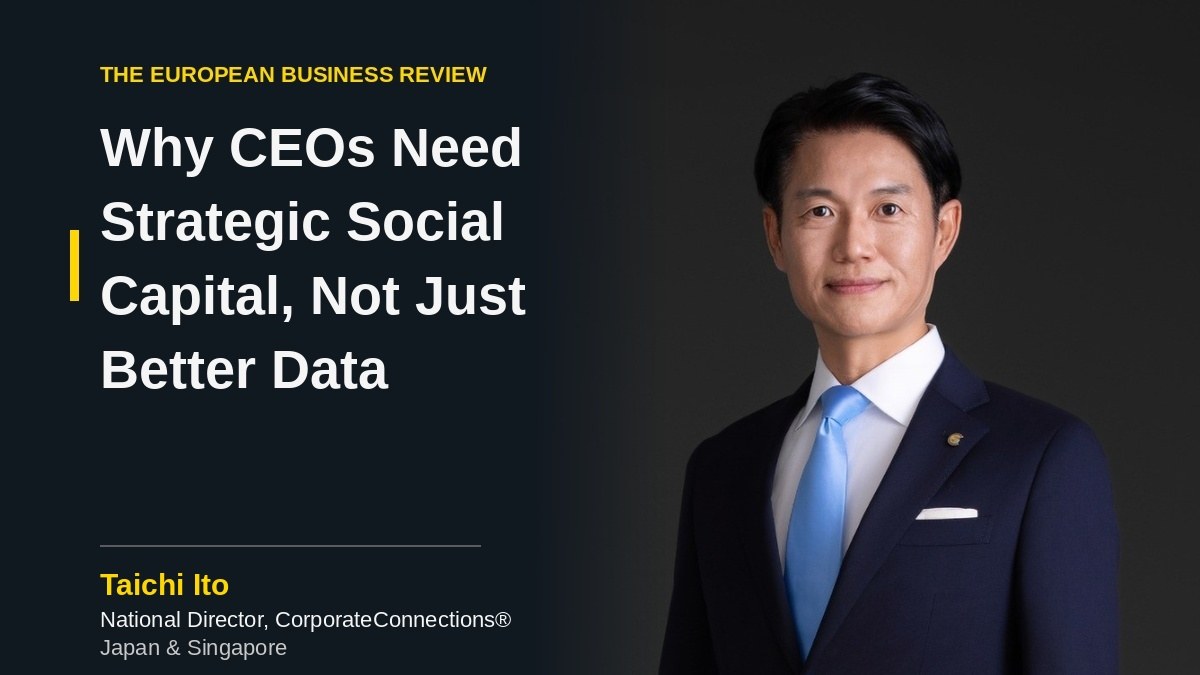
The Leadership Lesson: What Taichi Ito’s Strategic Social Capital Insight Means for Today’s CEOs
AI can give a CEO more information in seconds. But who helps a CEO decide what that information actually means and what to do with it?
As artificial intelligence (AI) transforms how businesses access data, analyze markets, and generate insights, the advantage for today’s CEOs may be shifting. The challenge is no longer simply having enough information. It is developing the judgment, perspective, and trusted relationships needed to turn information into better decisions.
In his recent article, “Why CEOs Need Strategic Social Capital, Not Just Better Data,” published by The European Business Review, Taichi Ito, National Director of CorporateConnections® Japan and Singapore, explores this increasingly important dimension of executive leadership and decision-making.
Taichi introduces the concept of Strategic Social Capital—the value created through trusted relationships with other experienced leaders who can challenge assumptions, share lived experiences and provide perspectives that data alone cannot.
When Information Is Everywhere, Judgment Becomes the Advantage
AI can analyze information at remarkable speed. It can identify patterns, summarize research, compare scenarios, and generate potential solutions.
But leadership decisions rarely exist in a vacuum.
CEOs are making decisions involving people, culture, risk, growth, markets, partnerships, and uncertainty. The most important question is often not “What does the data say?” but “What am I missing?”
That is where trusted executive relationships can become an important part of strategic decision-making.
A fellow CEO may have navigated a similar challenge in a completely different industry. Another leader may recognize a blind spot. Someone with a different cultural or market perspective may challenge an assumption that otherwise goes unquestioned.
These conversations do not replace data.
They help leaders interpret it.
The CEO Perspective You Cannot Find in a Dataset
Taichi also highlights an important distinction between advice and experience.
When one leader tells another exactly what they should do, the conversation can become prescriptive. But when leaders share what they experienced, the decisions they made, what surprised them, what they would approach differently, the listener gains something more valuable: another lens through which to evaluate their own situation.
The objective is not to copy another CEO’s decision.
It is to strengthen your own judgment.
This is one of the most powerful forms of peer learning for executives. Experience becomes a resource that can help leaders recognize patterns, challenge assumptions, and ask better questions.
The Quality of Your Executive Network Matters
This also changes how we think about executive networking.
A large network may create access. A meaningful network creates perspective.
The value of an executive network is not simply measured by how many people you know. It is measured by who you can learn from, who can challenge your thinking, and what you can contribute to the conversation.
The strongest relationships are built on trust. They create space for candid conversations that may be difficult to have elsewhere, particularly for CEOs and senior executives who often carry significant responsibility and may have fewer opportunities to speak openly about the challenges they face.
And when those relationships extend across industries, markets, and cultures, the diversity of experience becomes an advantage.
One leader’s challenge can become another leader’s learning.
One conversation can reveal a possibility that data did not.
One perspective can change the way a decision is viewed.
Why Human Connection Still Matters in the AI Era
The rise of AI does not make human connection less important. In many ways, it makes meaningful human relationships and leadership communities more valuable.
AI can provide information. Leaders provide context.
AI can generate possibilities. Leaders apply judgment.
AI can answer questions. Trusted relationships can help leaders ask better ones.
Questions for Today’s CEOs
Taichi’s perspective offers several questions for leaders navigating this changing environment:
- Who challenges my thinking?
- Whose experience can I learn from?
- Do I have trusted peers with whom I can discuss difficult decisions openly?
- Am I building relationships beyond immediate business opportunities?
- Am I learning from leaders whose industries, markets, and experiences differ from my own?
- What experience or wisdom can I contribute to other leaders?
The answers can reveal the strength of a leader’s Strategic Social Capital.
Because the goal is not simply to have more connections.
It is to have meaningful connections that make you a better leader—and to be the kind of leader who does the same for others.Read the original article in The European Business Review
Recent Posts
Leadership
 1 min read
 1 min read
 魅力的でかつ成功するリーダーになる方法...
現代の企業社会には、魅力的なリーダーが不可欠です。Partners In Leadership社の最近の調査によると、従業員が職場で幸福感を感じている時には、85%が「より自発的に行動するようになった」、73%が「より協力するようになった」、48%が「より仕事に関心を持つようになった」と答えています。魅力的なリーダーであることが、組織をより成功に導…
Leadership
1 min read
成功するリーダーシップ開発プログラムの作り方...
企業の成功において、強力なリーダーシップチームを持つことは不可欠です。企業は、組織の成長を後押しして将来のリーダーを育成し、前進し続けていくために、優れたリーダーを必要としています。多くの場合、強力なチームの構築を可能にするのは、優れた社内リーダーシッププログラムです。このプログラムでは、個人が優れたリーダーになるための資質や、模範を示して…